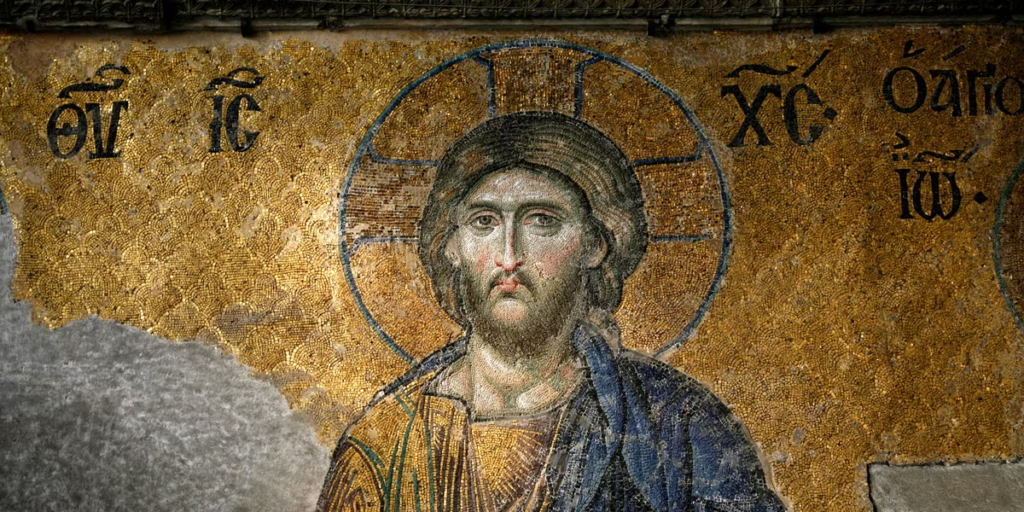

Religion has been a part of people’s lives since the beginning of civilization. The concept of Gods and a higher power have been around for thousands of years. Throughout human history every society has always worshiped a god or gods. Religion has always been a big part of any culture, the only difference is the type of religion and the Gods they pray to. Most societies throughout history lived their lives to honor the Gods they worshiped. Religion has always been a big part of any culture, the only thing that has changed is the type of religion and the God or Gods that are a part of those religions.
The Beginning of Religion
As society changed throughout history so has the impact religion has on that society. In almost every country and culture in today’s society there is some type of religion that is recognized and practiced. Over the years. however. the impact religion has on our society has changed drastically since ancient times. Along with the changing impact religion has on today’s society the number of religions has drastically changed as well. When civilization began so did religion, at which time there each culture practiced some form of religion. Although it is almost impossible to determine how many religions existed throughout the world we can learn about the religions they practiced through artifacts that have been found. In order to determine the effect religion has on our society today we must first look at the history of religions and the impact they had.
The belief in practicing a religion is believed to date back to the earliest known humans, which dates back over 40,000 years ago. It is hard to determine when the belief in a god and the afterlife first originated. Because this is many years before any form of writing would emerge it is impossible to determine what the beliefs of those religions were or when they first emerged. Much of the evidence proving some type of belief during these pre-historic times comes from the discovery of skeletons from that time period. The fact that humans started to bury their dead suggests that this was the beginning of religious beliefs.
Much of what is known about the earliest forms of religion comes from burial sites. Until around the time of 10,000 b.c. the only evidence of their way of life comes from these burial sites as well as objects that were made and placed with many of these sites. Because many of these objects were placed in the graves lead many people to believe that these objects were considered sacred. The use of sacred objects is more evidence of religious practice. It also tells us how these religious practices were beginning to evolve.

From the period of 10,000 b.c. to about 3,000 b.c. is when humans began carving monuments and building places of worship. One of the oldest man-made monuments built is located in Turkey and is known as GoblekiTepe. This site, which was built around 9600 b.c., is about 3 football fields in size and made up of many enclosed structures, many who believe are the earliest known temples built.
Many many made structures built during this time period have been discovered. Many archaeologists believe these monuments are places of worship. Structures, such as Stonehenge, as well as many statues and other carvings prove that the religious belief began to evolve. It also proves that the religion began to have a huge impact on the daily lives of people living during this period. Humans during this time period not only had to learn how to build these structures but would of had to spend a majority of there life building them as well. This evolution in the belief in religion brings us to the our next time period, 3,000 b.c. to the time when Christ was born.
Religion Becomes Organized
The beginning of civilization began in Mesopotamia around 6,000 b.c. This is the first time humans changed from being nomadic hunters/gatherers and became settlers using agriculture. There is evidence this change began to occur before this time, as seen with GoblekiTepi, but was a transformation that would take thousands of years. Mesopotamia is when we begin to see permanent housing and a society with different classes of people. The society began to rely on one person to make sure that society had all its needs. This was when the concept of a society having a king to rule over them was born.
During this time is also when we see history begin to be recorded. This is where we see the first form of writing, known as cuneiform, that used clay tablets. The society began to build and create anything that would make life easier for themselves. Items like pottery began to be made for a number of tasks. Staying in one location allowed humans to develop new materials, such as copper, which was the first metal created. Creating a civilized society that saw laws and rulers for the first time also changed how religion was viewed.
The concept of religion may have been around long before this period but this is the first time we see society develop organized religion. Society began to grow and expand into different cities. These new cities, who were polytheistic, began to worship named gods that each served a different purpose. Priests were in every city where people could go and learn about the different gods and how they needed to worship them. These gods had names and each looked different, some looking like us, while others could be a combination of different animals, such as the god Anubis depicted above.
Religion played a major part in the development and growth of society. Humanity began to evolve into a lifestyle that was unknown. As society’s developed their intelligence developed as well. Many of the concepts developed, such as agriculture, was needed to survive. They needed everything to work properly and because many of these concepts they did not understand something was needed to help them understand. When crops did not grow, or the rain did not come when needed, or it was too cold or hot they developed a concept to help them understand how they could control it and where it came from. The gods that were there to help society but required a form of worship. Different forms of worship began to be used depending on what God they were praying to or what their need was.
Religion Forms New Society
These concepts began to develop into organized religions, many of which we still see today. Ancient Egypt in 3000 b.c. society changed how they viewed religion. Religion became much more organized and was the foundation of how people would live there daily lives. It was the first time the concept of an afterlife became a part of religion as well the role kings, or pharaohs in Egypt, would play in society. Religion determined what the afterlife was and how people would be able to go to an afterlife. An afterlife was seen as having eternal life. In order to achieve eternal life was determined by your actions on Earth and by the pharaoh. The Pharaoh was seen as divine, essentially a god themselves, and was determined through a blood line.
The Pharaoh was how the people would communicate with the gods. He determined what the gods wanted and made sure they would keep providing what society needed to continue to flourish. Essential to life in Ancient Egypt was the Nile River, which was seen as being divine itself. Religion in Egypt had many gods, some more powerful and essential than others, who played a role for every aspect of life as well as the afterlife. The Pharaoh was seen as having a divine right to rule and it was his job to provide a god on earth whenever they were needed.
Two of the many gods Egypt had were considered the most important. The sun god Ra was the god of life and was responsible for day and night. The second god was Osiris, the god of the dead. Death became a major part of religion and many of the gods had to do with the afterlife. An afterlife being an essential part of religion had a huge impact on how people would live their daily lives. Many people spent their entire lives working to ensure they would reach the afterlife and achieve eternal life.
Much of society worked their whole life to ensure that the Pharaoh would make it to the afterlife. The concept of the gods needed for the Pharaoh to reach the afterlife would change throughout Egypt’s 3000 years. One of the most famous structures in the world is believed to be a tomb needed for the Pharaoh to reach the afterlife, the pyramid of Giza. It would take the pharaoh most of his reign to build it. It was completed in 2600 b.c. by the Pharaoh Khufu. The first pyramid was built about 70 years before the pyramid of Giza and had a huge impact on the role of people in Egypt.
The Effect Organized Religion had on Society
Egypt was the first society where the people lived their lives for religion and the gods they worshiped. Religion played a major part in determining the rules of Egypt and how it functioned. As society changed and grew the religion would change and adapt to those changes. Religion was used as a guide for how people would live their lives. Belief in the afterlife and being able to achieve traveling to the afterlife became a central part of peoples lives in Ancient Egypt, especially for the Pharaoh.
Without the contributions religion made to Ancient Egypt our societies would be much different today. Religion had many positive impacts on forming a civilized society that was able to evolve. The belief in the afterlife was a way to reach eternal life, but how they lived their life while they were alive determined whether or not they would be allowed to go to the afterlife. Many laws in society were followed because of the fear of not being able to go to the afterlife if they weren’t. Since the Pharaoh was seen as divine he would become a god in the afterlife and travel to the afterlife was much different than everyone else.
The methods of how the Pharaoh would reach the afterlife changed a few times during Egypt’s reign. The Pharaoh’s tomb was an essential part of the journey he would take to the afterlife. These tombs were built during a pharaoh’s lifetime. The concept of the tomb changed but not its function or how this function was achieved. Tombs were painted with many ancient texts that acted like a guide for the Pharaoh during his journey. One of the most famous texts used was from the book of the dead and the pyramid texts. Once the Pharaoh died many rituals had to be performed, including mummification.
The tasks that needed to be completed for the Pharaohs during their lifetime, such as the building of the pyramids, were a common goal for the people. It unified the people and allowed them to work together to ensure all tasks were completed within the timeline. Many of the tasks required tens of thousands of people to complete and gave them jobs for most of their lives. These tasks contributed to many advancements that have contributed to society. Advancements in engineering, math, and science may not have happened if it were not for religion.

Reaching the World Religions of Today
Since the beginning of civilization religion had a major impact and as civilization grew so did religion. New religions have been formed throughout our history and each new religion would use ideas from older religions. Today we have over 3000 religions in the world. Some of the most popular religions today are Hinduism (which many believe to be the oldest), Buddhism, Islam, Judaism, and Christianity (which is one of the newest religion). As these new religions were formed the effects they would have on society also began to change.
The Impact of Religion During the Common Era
Religion during the Common Era, since the birth of Jesus Christ, had a different impact than it did during the last 5000 years. As civilizations started to expand the amount of different religions expanded as well. New religions were formed by taking ideas from religions that already existed. Some of the most popular religions, which still exist today, are Hinduism (who many believe was the first religion), Buddhism, Islam, Judaism, and Christianity (which is one of the newest religions).
Once Rome recognized Christianity as its official religion during the 4th century it became one of the world’s most popular religions. This is also when we see a change in the impact religions would have, and it wasn’t necessarily the best impact. Many laws and rules that nations made during this time revolved around the religion of that nation. Penalties for breaking these rules and laws could be as severe as death. Most of the wars that were happening during this period were because of religion.
One of the biggest conflicts between religions, one that is still going on today, is between Christians and Islams. Most of Europe were Christian nations and Islam nations would try and invade different territories in Europe and convert them. Christians, however, would do the same thing and kill anyone who wouldn’t convert. Jerusalem, which is considered to be one of the holiest places on Earth by Judaism, Christians, and Islams, has been a territory that these religions have been fighting over for more than a thousand years. Religion began to be used as an excuse for nations to do or conquer whatever they liked, claiming they were doing what they were in the name of their God.
Christianity Changes the World
Christianity became one of the most popular and dominant religions in the world, especially in Europe. Because most of the United States is Christian and is seen as the most common religion it is the one I will be focusing on. Once Christianity became one of the most recognized religions starting in the 4th century it also became one of the most powerful. The Catholic church during much of the past 1500 years had more power than any nation in Europe. They also had more money than most nations in Europe during this time.
Many people who lived during this time period did not have a choice in the religion they practiced. The Catholic church would often force people to join their church and consequences for not doing so could be severe, even death. Many massacres that occured were done in the name of god. This control and power by the Catholic church would eventually lead to fighting amongst themselves. This led to the creation of different Christian sects that broke off from the Catholic church.
Luthern was the first Christian sect with its formation early in the 16th century. Martin Luther did not agree with many of the Catholic rules, especially with the ones relating to how a person can enter the kingdom of heaven. Once Luther broke away many others began to follow. The Catholic Church began to see its power starting to slip away. The church ruled by fear and this fear people had led many of them to donate their entire life savings. Because of religion people did not have the freedom to live their own life and instead lived their life for there church and followed their demands.
The Impact of Religion Today in the United States
The Catholic church today is still one of the wealthiest organizations in the world today. Many world leaders, including our own, still look to the pope for guidance. The impact they have today is much different than it was, not as violent and brutal, but they are still very powerful. Something that hasn’t changed are the wars being fought over relgion. The war happening right now in Israel with Hamas is over religion, a war that has been going on for over a thousand years. Conflicts all over the middle East are happening right now and all of them are over the nations religious beliefs and practices.
America is a nation that claims we have the freedom of religion, that we can practice our own religion without fear of persecution. From what I have seen that is something that does not happen. Many people are ridiculed because of their religion, or codemned because of the practices of that religion. You may be free to practice the religion you want, but that doesn’t mean you can do it without fear.
Another problem I have with religion is the claim of religion and state being separate. That has never been true and it is not true today. Every where you look you see evidence that religion had a big impact in the founding of this nation. Most of the slogans this country uses have to do with God. Our currency has “in God we trust” written on it. Some of our laws and rules were even written because of the impact of religion.
Many of our leaders have tried to make it mandatory for our children in school to participate in a morning prayer. Our schools have even taken out certain studies because of the contradiction they have with religion. Darwinism, for example, had many schools try and take the teaching of evolution out of the curriculum because of the contradiction. Religion continues to have a big impact in our country, and many of them are negative.
Conclusion
Religion began as something positive that helped our civilizations rise and expand. Many inventions that happened wouldn’t have if not for religion. Much of the advancements we have seen in architecture, astronomy, math, and many other advancements might not have happened without religion. Some of the world’s greatest ancient buildings, many still standing today, were built in the name of religion. Our way of life, advancements, and intelligence have grown tremendously over the last 7,000 years and it all started with the belief in religion.
Religion was used in ancient times so that people had a reason for how everything worked and something they could do if things didn’t start to work. If crops weren’t growing, or it would rain, flooding, any event they couldn’t explain or prevent religion was a solution to these problems. Polytheistic religions would be a god for almost every scenario and monotheistic religions worshiped a god that was all powerful. Sacrifices and other rituals would be done for the gods so that they would provide. The way the world was seen has changed a lot since ancient times and views have changed on almost everything, except religion.
Humans have always continued to learn and explore, to find a solution to the things we didn’t have one for. Our knowledge has increased tremendously and many things that could only be explained by the gods we now know through science how they work. We have become a society where we need evidence and seeing is believing. The Bible is the one book that hasn’t changed at all and people still believe in what it says, even though none of it can be proven. We don’t know where the books of the bible come from, who wrote them, or when they wrote them. Yet, people are still willing to follow what that book says over what we know to be true and not true.
When religion starts to interfere with our ability to learn because it contradicts what it says then it is no longer a benefit. At this point in time it becomes more harmful than beneficial. I have had people ask me how I can explain the things science doesn’t have an answer for. They will tell me the only answer is religion or God. 200 years ago we couldn’t explain gravity, or lighting, or how we breathe. Things that we can’t explain today doesn’t mean they can’t be explained, it just means we can’t explain them yet. Instead of just saying the reason is God we need to study the situation and learn from it and find a solution. Religion should not prevent us from doing this.
We have seen religion interfere with learning our history. If history contradicts what the bible says then they will not want to teach it. There were some schools that were trying to ban the teaching of Darwinism and the dinosaurs, because they are in direct contradiction of the bible. People are always changing their views when new evidence is presented to them, why can’t we do that when it comes to religion.
I am not saying that religion is all bad. It does have its benefits and it makes people feel better to have it in their lives. It gives them a guideline of how they should live their lives. It takes away the fear of death and the unknown and gives them an afterlife to believe in. If people feel better in life with religion then I don’t see anything wrong with believing in whatever you want. My problem comes when it starts to interfere with the society you are living in and actively harming them.
I wonder what our world would be like without religion. What would the reason for the wars start to become? Would we be able to make advancements instead of using religion as an excuse to hold us back. There are many things about this topic I don’t understand and probably never will in my lifetime. I am confident however we will understand them one day. The biggest question I am asked when it comes to religion is what I think happens to us after we are dead. I do have my own theories about this but they are just that. The answer is I don’t know. But just because I don’t know doesn’t mean I am willing to follow something that I don’t believe and doesn’t make sense to me.

Leave a Reply